Guys, I shoot 100 to 150 rounds every session.
If I posted targets of each group one time, I would overrun the limits this site allows for the number of files posted.
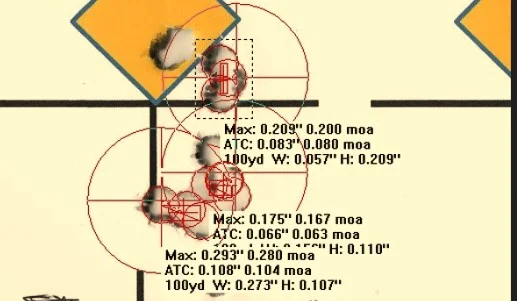
For those of you who don't measure, here are a few examples of what measuring does for me.
This shows you why I always talk about the one out that could mess up a group.
The top group was aimed at the bottom point of the diamond, and it was slightly high and to the right. I usually shoot two or three different bullet weights with the same rifle during the session, and I know that different bullets adjust to the barrel twist differently and I don't bother adjusting the scope because the next bullet will have to be adjusted anyway.
The top group was the first I shot and the just cleaned barrel usually shoots slightly high for one or two shots, and it did. Then I shot 5 rounds that landed slightly lower and further to the right.
The second group was aimed at the lower tip of the vertical line, and one of six rounds was the 'one out' caused by my 'Shooter Induced Variations (SIV).' I shot 6 rounds and "X'd out" the one that got away and shot the sixth round into the group. The last round might have dropped a bit from barrel heating. I am interested in the performance of the rifle, bullet, seating depth, jump, velocity, bullet in neck and exit time (matched to the OBT).
My shooter induced variations are recognized but I consider them a bias against the performance of the rifle and the other factors.
The last group was with a slightly heated barrel that usually drops the POI. One of the rounds was pulled slightly left but I didn't have another bullet to try to get another round back toward the aim point.
Here is another example that is posted in another post on this site.
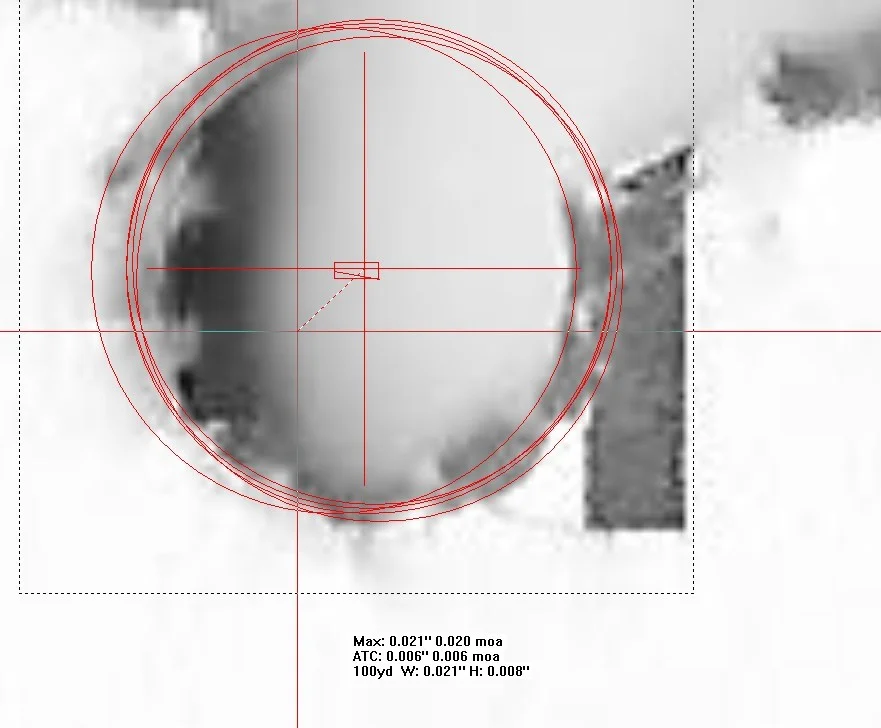
This is the best group I have ever shot (one out of over 14,000 groups I have measured).
I had to blow it up a lot to be able to find the edges of each bullet of the 5. With the new barrel, I have shot about 32% of my groups under 0.200 but only about 8 under 0.100.
This is the only group I have ever shot that is under 0.050.
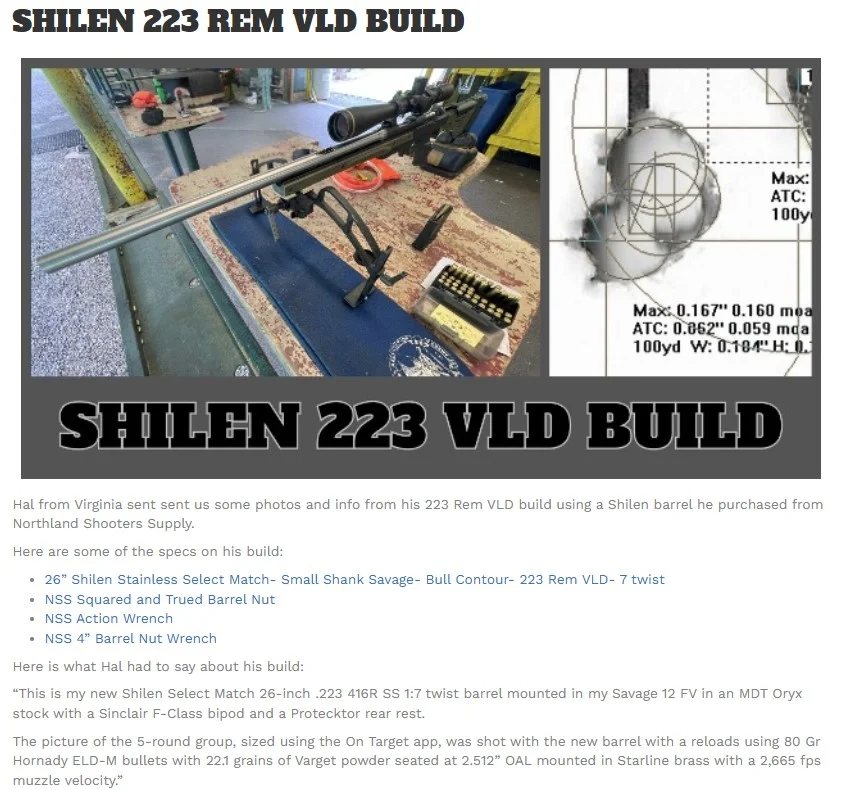
Here is another example of a post from a different site.
This is report by James of Northland Shooting Supply he published right after I sent him the attached group size. It was measured right after I got my new barrel. The seating depth was a bit shorter than I found performed better with the 80 grain bullets but the group was still a good one. You'll notice that the 80 gr ELD-Ms were just about right on my aim point.
Actually, I try not to have the POI actually hit the aim point because the bullet holes destroy the much smaller aim point and make precise aiming more difficult.
I think you can see why I measure and keep records of my measurements.
I'm sorry, but I am just not going to post the pictures of the 16 to 24 groups I shoot each week.
There are some good ones and some not so good ones, as you can see from the measured group sizes in my posts, but I record all of them. Once I measure the groups, the pictures have no value to me.
My shooter induced variations are included in my range reports, but I consider them a bias against the performance of the rifle and the other factors. That bias makes conclusions about what works best misleading. So when I want to know what is working best and what bullets I should be buying, and what loading data I should be using, I try to eliminate the bias caused by my 'Shooter Induced Variations'.
I generally calculate two sets of numbers - the average for the load based upon all the measured numbers that you see in the range reports - and - the average of the loads that don't contain group sizes that are clearly outside the group sizes that don't contain known SIV. That turns out to be about 70+% of my groups.
That adjusted data is what I use to decide on what bullets, jump, bullet in neck, seating depths and powder charges that work the best. That is also what I use to determine if the OBT is actually the most accurate means of loading.












 I want to get out too. I don't feel good often. Chronic pain sucks.I wont drive when i take percocet.